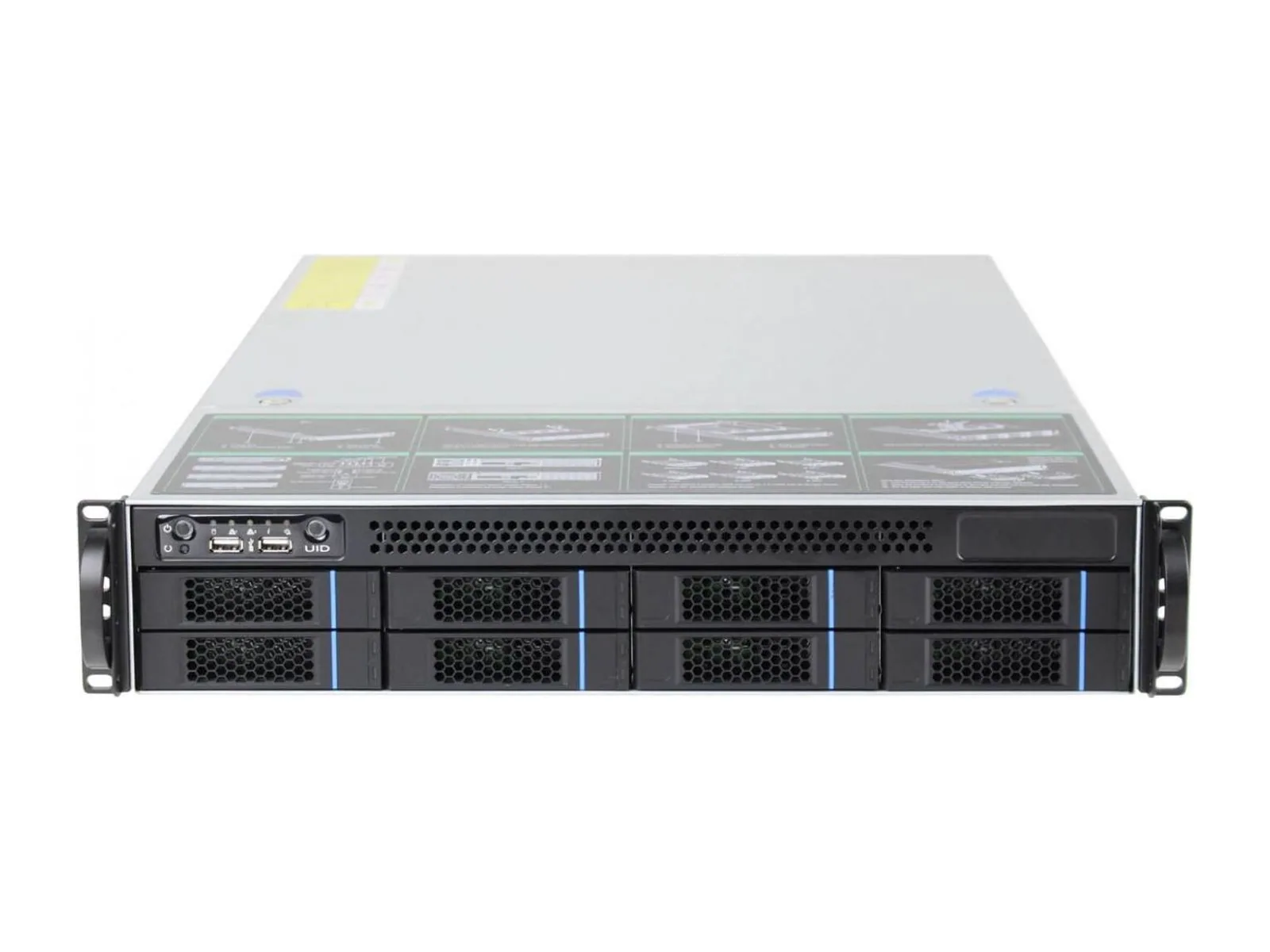
NetBytes SRS1
Dual-socket 2U rack server with an 8-bay tri-mode backplane, 4TB memory capacity, and flexible NVMe/SAS/SATA storage for virtualization and database workloads.
Overview
The NetBytes SRS1 is a dual-socket 2U rack server engineered for Indian enterprises running virtualization, private cloud, and database workloads at scale. Built on the Intel C741 chipset, it supports dual 4th/5th Generation Intel Xeon Scalable processors, giving IT teams a clear upgrade path as core counts and workload demands grow without a platform refresh.
At the heart of the SRS1 is a 16-slot DDR5 memory subsystem scaling up to 4TB, sized for memory-hungry hypervisors, in-memory databases, and consolidated VM density. The 8-bay tri-mode backplane is the standout feature — configurable as 8x SAS/SATA for capacity-first deployments, or 4x SAS/SATA plus 4x NVMe for a hybrid tier that keeps hot data on flash while archiving to spinning or SATA SSD storage, all through a single hardware RAID controller without separate NVMe switches.
Networking starts with dual onboard 1GbE ports for management and basic connectivity, backed by a dedicated IPMI port for out-of-band remote administration. A PCIe expansion slot accepts add-in NICs from 10GbE up to 100GbE, so the same chassis serves a branch database server or a top-of-rack cloud node depending on which card is fitted at deployment.
Power comes from an 800W CRPS supply, sized for dual high-core-count Xeon CPUs plus a fully populated drive bay, with redundant configurations available for HA deployments. The SRS1 is validated with mainstream hypervisors (VMware ESXi, Proxmox VE, XCP-ng) and enterprise Linux/Windows Server operating systems, making it a straightforward fit for virtualization clusters, private cloud stacks, and transactional or analytical database tiers alike. Every unit ships after burn-in testing and is built to BIS, FCC, RoHS and EMI/EMC compliance under Spectra's ISO 9001/27001/14001-certified manufacturing process.
Why choose the NetBytes SRS1
- Dual Intel Xeon 4th/5th Gen support on Intel C741 chipset for a multi-generation upgrade path
- 16 DIMM slots scaling to 4TB DDR5 for memory-intensive virtualization and database workloads
- 8-bay tri-mode backplane switches between all-SAS/SATA and hybrid NVMe configurations
- PCIe expansion from 1G onboard up to 100GbE for flexible network tiering
- 800W CRPS redundant-capable power supply sized for dual-CPU, fully-populated configurations
- Dedicated IPMI port for lights-out remote server management
- Burn-in tested 24-72 hours and manufactured under ISO 9001/27001/14001 processes
Technical specifications
- Form Factor
- 2U Rack
- Processor
- Dual Intel Xeon Scalable (4th/5th Gen), Socket LGA4677, Intel C741 chipset
- Memory
- 16x DDR5 DIMM slots, up to 4TB
- Storage
- 8-bay tri-mode backplane — 8x SAS/SATA or 4x SAS/SATA + 4x NVMe
- Networking
- 2x 1GbE onboard; PCIe add-in card support for 10/25/40/100GbE
- PSU
- 800W CRPS, redundant configuration available
- Expansion
- PCIe slots for NIC, HBA and RAID add-in cards
- RAID
- Hardware RAID controller, tri-mode SAS/SATA/NVMe support
- Management
- 1x dedicated IPMI port for out-of-band remote management
- Operating System
- VMware ESXi, Proxmox VE, XCP-ng, RHEL, Windows Server
- Certifications
- BIS, FCC, RoHS, EMI/EMC
Built for virtualisation and private cloud at scale
Consolidation workloads live and die by memory and core density, and the SRS1 is built around both. Dual 4th/5th Gen Intel Xeon Scalable processors on the C741 chipset give hypervisor clusters the core headroom to run dense VM counts, while 16 DDR5 DIMM slots scaling to 4TB memory keep pace with memory-ballooned virtual machines and in-memory caching layers. IT teams standardizing on VMware ESXi, Proxmox VE, or XCP-ng get a validated platform without compatibility guesswork. The onboard IPMI port means cluster nodes can be provisioned, monitored and power-cycled remotely from day one, which matters when nodes are racked in a colocation facility or a branch data center with no on-site hands. For private cloud deployments building out API-driven infrastructure, the SRS1's PCIe expansion means the network fabric can be upgraded from 1GbE to 100GbE as the cluster grows, without replacing the chassis.
Storage that adapts to the workload, not the other way round
Database administrators and storage architects rarely agree on one storage layout, which is why the SRS1's 8-bay tri-mode backplane is configured, not fixed. Deploy all 8 bays as SAS/SATA for capacity-oriented archival and backup-adjacent database tiers, or split it 4-and-4 with NVMe drives handling hot transactional data while SAS/SATA handles warm storage — all behind a single hardware RAID controller. This flexibility means the same base chassis serves an OLTP database server needing NVMe latency and a general-purpose file or application server needing bulk SATA capacity, letting procurement standardize on one SKU instead of stocking separate storage-optimized and compute-optimized variants for different departments.
Manufactured in India, and tested before it leaves
Every NetBytes SRS1 unit is integrated and tested under Spectra's ISO 9001, ISO 27001 and ISO 14001-certified manufacturing process, with a 24 to 72 hour burn-in cycle before it ships, catching early-life component failures before deployment rather than after. The 800W CRPS power supply is sized for dual high-core-count Xeon CPUs with a fully populated drive bay, and redundant PSU configurations are available where uptime planning calls for it. Compliance marks include BIS, FCC, RoHS and EMI/EMC, giving procurement teams the documentation needed for government and enterprise tenders. For Indian IT teams comparing landed OEM server costs against locally built alternatives, the SRS1 is priced and configured to be evaluated against the equivalent import build on a like-for-like basis, quantified per configuration at the time of quotation.